

Chris Cooper, Principal Consultant – Mine Closure and Transition
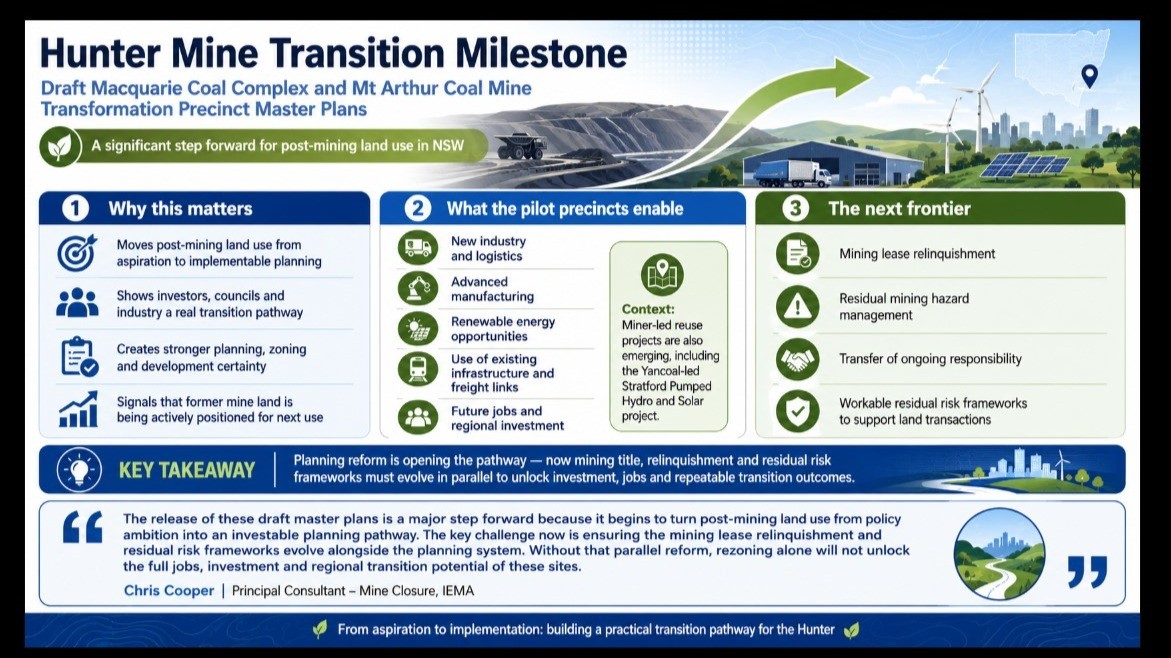
The release of the draft Macquarie Coal Complex and Mt Arthur Coal Mine Transformation Precinct Master Plans and state-led rezoning proposals are a significant milestone for the Hunter.
“The release of these draft master plans is a major step forward because it begins to turn post-mining land use from policy ambition into an investable planning pathway. The key challenge now is ensuring the mining lease relinquishment and residual risk frameworks evolve alongside the planning system. Without that parallel reform, rezoning alone will not unlock the full jobs, investment and regional transition potential of these sites.”
There are examples of miner-led post mining development proposals, including the Yancoal led Stratford Pumped Hydro and Solar project on the closed Stratford Coal Mine in Gloucester valley. This is another exciting milestone, approved in the same week as the release of the draft pilot master plans. However, these plans represent broader strategic planning for the Hunter’s mined lands transitioning to a decarbonised economy move beyond broad policy discussion and into a publicly exhibited planning framework that starts to show investors, local government and industry what a real transition pathway could look like. That matters, not just because of the scale of the opportunity these pilot sites present, but because it begins to shift post-mining land use from aspiration to implementable planning.
These plans are ambitious for good reason. They position Macquarie Coal and Mt Arthur as future employment precincts that can leverage scale, existing infrastructure, strong regional freight connections and proximity to skilled workforces to support new industry, logistics, advanced manufacturing, renewable energy and other employment-generating uses.
Just as importantly, this is driven through state-led rezoning processes and draft master plans that start to provide the sort of spatial and policy certainty investors have been waiting for. That signalling really matters. Former mine land is rarely constrained by a lack of ideas. More often, it is constrained by uncertainty, uncertainty about zoning, about what development pathway applies, about whether future uses are genuinely contemplated by government, and about whether technical site constraints will be managed in a way that makes investment realistic rather than speculative.
A master planned, state-led rezoning pathway begins to reduce that uncertainty. It tells the market that this is not just land awaiting closure; it is land being actively positioned for a next use. It is a signal to the market that the Hunter is serious about land transition, and that government is prepared to use planning tools to bring structure, sequencing and visibility to the process.
In practice, that means better signalling of where early activation may be possible, how development can be staged, what further investigations may be needed, and how post-mining land might transition from coal production to productive new uses.
But this planning milestone will not be mistaken for a complete transition solution.
The (arguably) harder parallel task remains the one that sits outside the rezoning package: how NSW deals with mining lease relinquishment, residual mining hazard management and the transfer of ongoing responsibility once post-mining development becomes real. The draft planning framework is a major step forward in opening a pathway for rezoning, master planning and future development consent. What it does not yet resolve, and what it openly acknowledges will require further reform work, is the interface with the Mining Act and the mechanisms needed to make land transactions genuinely workable.
That is the next frontier.
For many sites, the central issue will not be whether a future use can be imagined or even master planned. It will be whether land can be released from mining tenure with enough certainty around residual risk, rehabilitation interfaces and ongoing management obligations to allow a transaction to occur. Investors can price risk. What they struggle with is uncertainty about who ultimately carries it, how long obligations persist, and whether a parcel can be transacted without the former mining operator remaining exposed to open-ended liability.
This is where NSW still needs to do the heavy lifting. If the state wants these pilot projects to become repeatable models, it will need workable mechanisms for the transfer or retention of residual risk, whether through a government-managed framework, successor security or bonding arrangements, residual risk payment models, consent-linked obligations on a developer, or a hybrid of these tools. The exact model can be debated. The need for one cannot.
That is why the Hunter’s pilot project milestone is worth celebrating, but also worth reading carefully. The real progress here is not only the land use vision. It shows the NSW government intent to deliver planning pathways that will meet the economic transition challenge in the Hunter. A key outstanding task to deliver the jobs and investment we need is to make sure the mining title, relinquishment and residual risk frameworks evolve in parallel.
If that happens, Macquarie Coal and Mt Arthur will be more than successful pilots and will deliver a genuine template for how NSW mining regions can turn former mine land into future industry, investment and jobs.