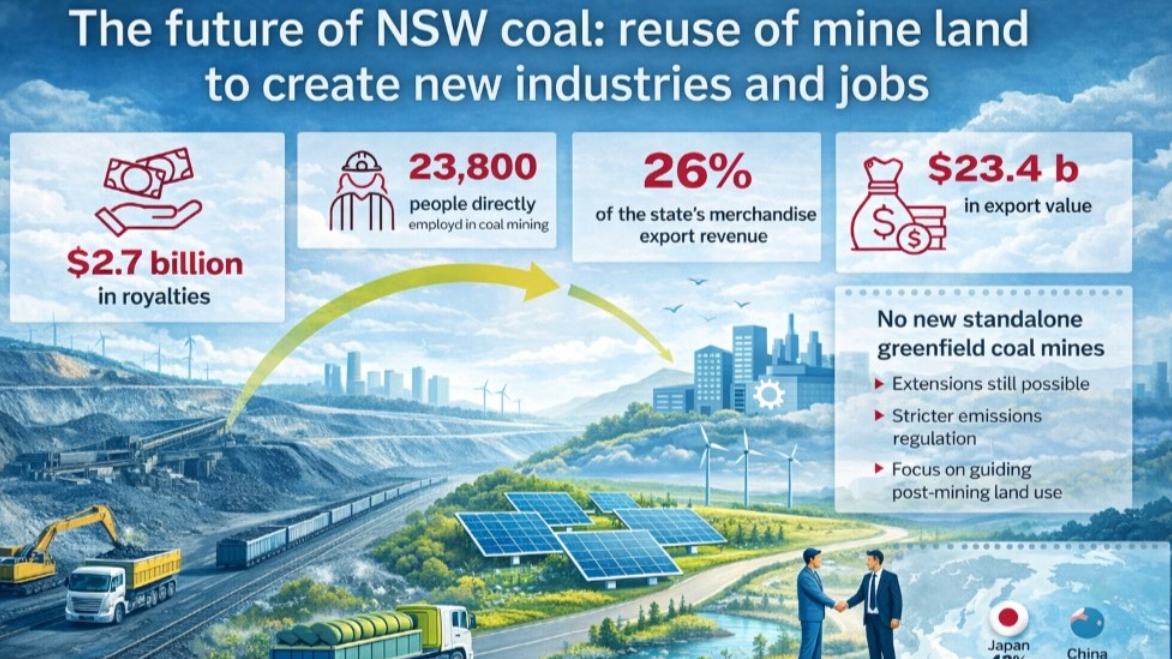
The NSW Government’s newly released direction for coal mining to 2050 provides one of the clearest signals yet about how the sector is expected to evolve over coming decades.
At a high level, the message is balanced but firm. Coal will continue to play an important role in supporting the state economy, regional jobs and export markets, but that future will sit within tighter boundaries. The framework signals continuity for existing operations, stronger emissions expectations, no support for new standalone greenfield coal mines, and a more deliberate focus on how coal-producing regions prepare for structural change over time.
Importantly, one of the best outcomes from this release is that it provides greater certainty.
That certainty matters. It helps industry, government and regional communities make better decisions about investment, approvals, mine planning, closure and transition. Even where parts of the message are restrictive, clarity is still better than ambiguity. A known framework gives everyone a clearer basis for planning than an uncertain one.
Coal remains economically significant to NSW
The report is also a timely reminder that coal remains a major contributor to the NSW economy.
The 2025 calendar year statistics are significant:
- $2.7 billion in royalties
- 26% of the state’s merchandise export revenue
- 35 mines produced coal
- 23,800 people directly employed in coal mining
- $23.4 billion in export value
Those are not marginal numbers. They reflect an industry that still underpins regional employment, state revenue and export performance.
The report also reinforces that NSW coal continues to have a strong market in Asia, particularly because of its quality. Export destinations in 2025 were led by Japan (43%), China (27%) and Taiwan (10%), with additional demand from South Korea (4%), Vietnam (4%), Malaysia (4%), Thailand (3%) and India (1%).
That is an important point in this discussion. NSW’s high-quality coal still has demand in Asia, and that demand continues to support local jobs, regional economies and export income. So while the policy is clearly about managing a long-term transition, it also recognises the ongoing role of the sector in supplying established export markets.
What the policy direction is really saying
This is not a message of immediate withdrawal from the sector, nor is it a signal of unconstrained growth. It is a policy position built around three themes: support for existing mines, constraint on new greenfield development, and a growing focus on transition and post-mining land use.
The key principles are relatively clear.
NSW is indicating that the coal industry will continue to support local economies and deliver reliable supply to trading partners. Existing operations remain important, and the government recognises that there are sufficient coal reserves at or near many existing mines to meet forecast local and export demand through extensions.
At the same time, the State has drawn a distinct line on new development. NSW will not consider applications for new greenfield coal mines. Exploration will be permitted near existing mine sites, but new greenfield coal exploration areas will not be opened up, and government investment in coal exploration will end.
For existing mines and extensions, the pathway remains open, but only through robust project-by-project assessment and increasingly strong regulatory expectations. Emissions are clearly central to this. Scope 1 and Scope 2 emissions, as well as local impacts and continuing consideration of Scope 3 emissions, will remain part of the assessment framework. The industry is also expected to keep contributing to the State’s net zero objectives through operational abatement, monitoring and the use of offsets where abatement is not feasible.
In simple terms, NSW is saying: existing mines can continue and may extend where justified, but the sector’s future must align with stronger environmental controls, emissions management and a planned approach to economic transition.
What this means for the sector
For industry, this creates a clearer picture of where investment and strategy should be focused.
The biggest winners from a certainty perspective are existing operations with extension potential. Mines with reserves near existing footprints now have a more visible policy pathway than speculative new standalone developments. The framework supports continuity, but it also raises the bar on how that continuity is justified.
That certainty is valuable. It gives proponents, investors, communities and regulators a more stable basis for planning. It also provides a more realistic foundation for conversations about closure, regional development and future land use.
For proponents, this means the future of coal mining in NSW will increasingly be shaped by:
- extension pathways rather than greenfield expansion
- stronger emissions performance and clearer abatement expectations
- continued scrutiny of local and broader environmental impacts
- rehabilitation that is not treated as a final compliance step, but as part of a longer-term land use strategy
For coal regions and communities, the framework also acknowledges a reality that has been building for some time: even where existing coal mines continue, change in global coal demand will influence the long-term future of regional economies. The role of the Future Jobs and Investment Authority, and the commitment to implement the recommendations of the Legislative Council inquiry into beneficial and productive post-mining land use, reinforces that transition planning is no longer peripheral. It is now part of the mainstream policy conversation.
The most important opportunity: reuse of mine land
For me, one of the most significant elements in the framework is not just what it says about mining approvals, but what it says about former mining land.
This deserves real emphasis.
The report points to a future in which former mining land can support new industries and jobs. It recognises that the reuse of existing mine infrastructure and assets may create opportunities to establish new economic activity, attract investment and deliver long-term regional employment. It also makes clear that government intends to play a more active role in providing guidance, planning support and strategic coordination to help unlock these outcomes.
That is a very important shift in emphasis.
Too often, post-mining land has been treated primarily as a closure liability, something to be stabilised, secured and left behind. While safe and stable rehabilitation remains essential, that cannot be the end of the conversation. The stronger opportunity lies in recognising post-mining land as a strategic regional asset.
The reuse of mine land has the potential to reshape how we think about closure and transition.
Done well, it can:
- create a platform for new industries
- make productive use of existing infrastructure and disturbed land
- attract investment into regional economies
- support job creation beyond the life of the mine
- turn rehabilitation from a compliance endpoint into an economic development opportunity
That does not mean every site will support every use. The report rightly notes that future land uses will always depend on site-specific physical, environmental and economic factors. Some sites will lend themselves to new industrial or energy uses. Others may support conservation, agriculture, water management, logistics or mixed outcomes. The point is not that every site has the same answer. The point is that reuse should now be part of the planning mindset much earlier in the mine life cycle.
Still work to do: enabling flexibility in the planning pathway
While the direction is positive, there is still important work to do in enabling greater flexibility within planning and approval pathways to support beneficial reuse outcomes.
In particular, there remains a real challenge where a mine operator or landholder identifies a sensible and productive post-mining land use, but the pathway to achieve that outcome may require reopening or materially amending full development consents. In practice, that can create delay, cost and uncertainty, even where the proposed reuse is logical, lower impact and strongly aligned with regional needs.
If NSW is serious about encouraging beneficial reuse of mine land, the planning framework should continue evolving to allow more practical pivot points. There should be mechanisms that enable a transition to an appropriate beneficial reuse outcome without automatically having to open up the full consent architecture each time.
That does not mean lowering standards or avoiding proper assessment. It means creating a planning system that is flexible enough to support adaptive reuse, respond to new opportunities, and recognise that the best post-mining outcomes may become clearer over time as markets, technologies and regional priorities evolve.
This is where further reform could add real value. Greater certainty at the strategic level is a big step forward, but flexibility at the implementation level will be just as important if the policy is to deliver real outcomes on the ground.
Final reflection
The NSW coal framework to 2050 is, in many ways, a statement of managed transition.
It recognises that coal still delivers very substantial value to NSW through royalties, export income, employment and regional economic activity. It also acknowledges that NSW’s high-quality coal continues to attract demand in Asia, particularly in established export markets such as Japan, China and Taiwan.
At the same time, it supports the continuation of existing coal mining under stricter expectations, closes the door on new standalone greenfield coal mines, reinforces the importance of emissions management and robust regulation, and places greater attention on the future of coal-producing regions and the productive reuse of former mining land.
One of the best aspects of the framework is that it now provides a greater degree of certainty. That is valuable in itself.
The next step is making sure the planning system is flexible enough to convert that strategic direction into practical reuse outcomes on the ground.
Because the long-term success of mining regions will not be measured only by how well mines close. It will be measured by how effectively former mine land is repositioned to support the next chapter of regional industry, investment and employment.
The real opportunity is to stop seeing mine closure as the end of the story.
Instead, we should see the reuse of mine land as the bridge between resource extraction and regional renewal.