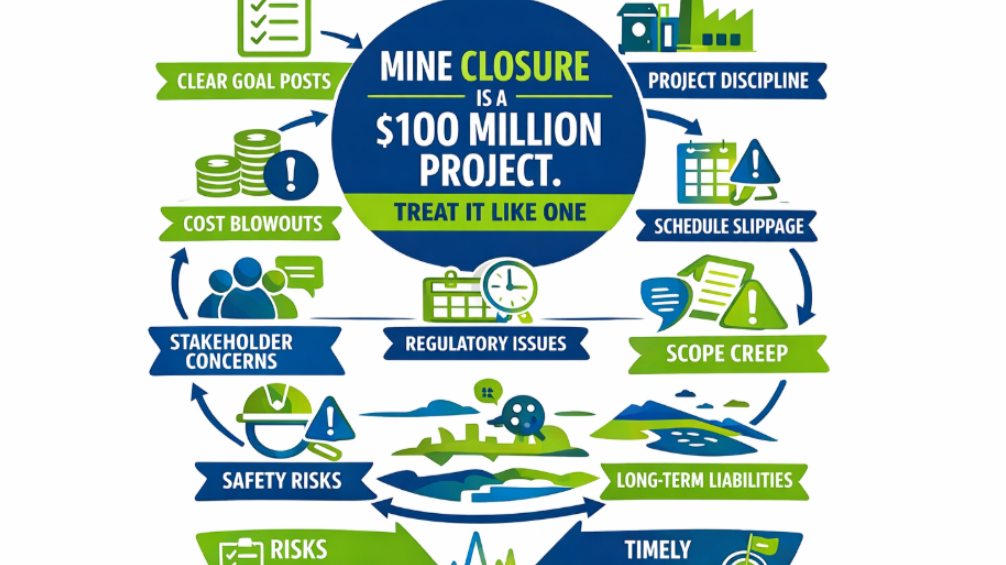
This week I had a meeting with a client who gets it. They understand that closure is a major project, they’re supportive of lifting maturity, and they’re pushing for stronger governance and delivery discipline. The challenge they’re wrestling with is a familiar one: how to communicate this reality through a corporate executive team where closure can still be viewed as “rehab” rather than a nine-figure delivery program with long-tail risk and a clear relinquishment end point.
Closure is routinely a nine-figure endeavour. In many cases, it is one of the largest “projects” a site will ever deliver. And yet, across the sector, closure is still too often managed as something other than a project, treated as a technical program, a compliance activity, or an operational afterthought.
This isn’t an abstract idea. It’s coming through clearly in conversations with clients right now, as they navigate internal discussions about how closure should be planned, governed, resourced, and delivered. In many organisations, there’s a genuine push to lift maturity. But there’s also a persistent mindset that closure sits outside “normal” project discipline.
That difference in mindset matters. Because when closure is not governed like a project, the costs and liabilities don’t disappear, they compound. And just as importantly, the pathway to timely relinquishment becomes harder to see, harder to manage, and harder to achieve.
The mismatch: capital discipline everywhere… except closure
If a business was building a wash plant, an expansion, or a new piece of critical infrastructure, the early questions would be familiar:
- Who is the accountable owner?
- What is the baseline scope, schedule and budget?
- What are the decision gates and governance?
- How will risk be identified, tracked and controlled?
- What does “success” look like and how will we measure it?
Our experience is closure doesn’t always get the same interrogation, despite the fact that it often carries higher uncertainty, longer time horizons, and more stakeholder scrutiny than many capital projects.
The result is a predictable pattern: closure drifts, decisions can get deferred, scope creeps quietly, and obligations are left to “future teams” to solve which almost always means relinquishment moves further away, not closer.
Closure is a product (and it needs delivery discipline)
Closure isn’t just “rehab.” It is a product with defined outcomes, and those outcomes need to be translated into clear goal posts that a site can work toward, measure, and ultimately demonstrate for sign-off and relinquishment:
- landform and water performance criteria
- erosion stability and geotechnical integrity
- habitat establishment or end land use delivery
- regulatory sign-off and long-term monitoring obligations
- community expectations and reputational exposure
- material movements, civil works, and infrastructure decommissioning
All of this sits on top of a simple truth: the liability exists whether you manage it or not. The only choice is whether you control it early with clear completion criteria and decision discipline or pay for it later through extended monitoring, rework, and delayed relinquishment.
A missing piece: a closure risk profile that flows through delivery
One of the biggest challenges I see in discussions is that closure risk is often recognised, but not consistently identified, owned, and managed end-to-end.
On strong capital projects, risk is not a one-off workshop. It becomes a living system:
- identified early, as part of option selection and design maturity
- quantified, prioritised and assigned owners
- tracked through controls (schedule, cost, approvals, technical performance)
- reviewed at decision gates
- used to shape contingency, staging and delivery sequencing
Closure needs the same approach, because closure risk is not only “environmental risk.” It spans technical performance, approvals, stakeholder trust, cost, schedule, safety, and long-term liability. And if the risk profile doesn’t flow through the program, it shows up later as avoidable delays to sign-off and relinquishment.
Practically, this means:
- building a risk register aligned to closure outcomes and completion criteria (the goal posts)
- linking risks directly to the work program (mitigations are actions with owners, budgets, and dates)
- linking risks to assumptions (and actively testing/retiring assumptions through studies and trials)
- maintaining a clear line of sight between risks and relinquishment blockers (what will stop sign-off?)
- routinely re-baselining risk as the design matures and site conditions evolve
In short: closure should have a risk story that is coherent from strategy → plan → execution → monitoring → sign-off.
What happens when closure isn’t treated like a project?
Below is a breakdown of the most common risk categories that emerge when closure is managed without strong project governance, study management, and delivery controls, and without clear goal posts that keep relinquishment in view.
1) Cost blowouts and “late surprises”
What it looks like: Budget estimates based on incomplete studies, optimistic assumptions, or outdated inventories.
Why it happens: Without structured definition phases (think pre-feasibility/feasibility equivalents), closure scope and quantities remain fuzzy. Unknowns become “contingency” until they become real invoices.
Impact:
- escalating provision and cash calls
- sudden capital reallocations
- loss of credibility with executives, Regulators and investors
- pressure to cut corners to “get back on budget”
- relinquishment pushed out as “fix later” becomes the default
2) Schedule slippage that quietly becomes permanent
What it looks like: Rehab targets that roll year after year; “we’ll do it next shutdown / next FY / next phase.”
Why it happens: Closure schedules are often treated as aspirational, not controlled. Dependencies (approvals, seasonal windows, material availability, access constraints) aren’t managed like a proper program.
Impact:
- extended monitoring and maintenance costs
- delays in relinquishment
- prolonged risk exposure (erosion, water, safety)
- legacy burdens handed to future leaders
- a growing gap between “activity completed” and “goal posts achieved”
3) Regulatory non-compliance and loss of trust
What it looks like: Late submissions, misaligned commitments, conditions that can’t be met, or reporting that doesn’t match reality.
Why it happens: If closure isn’t governed, decisions get fragmented across departments. Commitments are made without integrated planning, and “compliance” becomes a scramble.
Impact:
- s240s, enforcement action, notices, and tighter licence conditions
- delayed approvals for future operational changes
- higher oversight and scrutiny
- reputational damage with regulators and community
- longer pathways to sign-off because trust and evidence are weakened
4) “Scope creep” through a thousand small decisions
What it looks like: Small changes in landform design, water controls, material sourcing, infrastructure removal, or final land use… each sensible in isolation.
Why it happens: Without change control and decision gates, closure evolves informally. The cumulative effect isn’t visible until budgets and timelines blow out.
Impact:
- loss of design integrity and performance intent
- misalignment between plan and execution
- large rework packages late in the piece
- completion criteria become moving targets, delaying relinquishment
5) Safety and operational conflicts
What it looks like: Closure works competing with production priorities; unclear interfaces; inconsistent contractor management.
Why it happens: Where closure is not treated as a project, the interfaces between operations, maintenance, environment, and projects are not formally managed.
Impact:
- elevated safety exposure for crews and contractors
- disrupted production schedules
- higher incident likelihood during decommissioning and earthworks
- delays as work is stopped, re-scoped, or re-approved
6) Poor closure outcomes that create long-term liability
What it looks like: Landforms that don’t perform, drainage lines that fail, erosion that escalates, vegetation that won’t establish, water quality issues that persist.
Why it happens: Closure performance is often only fully understood over time. If the upfront studies and performance criteria aren’t robust, and if execution isn’t controlled, you run the risk of building in failure.
Impact:
- repeated remediation cycles
- ongoing maintenance obligations
- difficulty achieving sign-off and relinquishment
- higher financial assurance and long tail costs
- a widening distance between “work completed” and “relinquishment achieved”
7) Stakeholder blowback and reputational damage
What it looks like: Community frustration, social licence issues, and increased scrutiny from investors and boards.
Why it happens: Closure is highly visible, emotionally charged, and often linked to perceived “promises” made over years. Weak governance leads to missed expectations and reactive communication.
Impact:
- delays due to stakeholder resistance
- reputational harm that affects future approvals
- loss of trust that takes years to rebuild
- more difficult and slower relinquishment conversations
The governance shift that changes outcomes
Treating closure like a project doesn’t mean adding red tape. It means applying a level of discipline that matches the scale of the liability and keeps the pathway to relinquishment visible and achievable.
- Clear accountability: a single accountable project owner with authority
- Front-end definition: baseline studies, options analysis, and staged design maturity
- Controls: schedule, cost, risk and change management that are live and reported
- Decision gates: formal approvals at key points, not informal drift
- Performance criteria: measurable completion standards tied to closure objectives (the goal posts)
- Integrated delivery: operations, environment, approvals, and engineering aligned to one plan
- Risk flow-through: a closure risk profile that is owned, reviewed, and actively managed from strategy through to sign-off
In other words: closure should be managed like any other nine-figure delivery program…….because it is one. And because timely relinquishment depends on discipline, evidence, and keeping those goal posts stable and measurable.
A $100+ million closure deserves $100 million project discipline — with clear goal posts that lead to timely relinquishment.
If you’ve seen closure managed well, what made the difference? And where do you see the biggest gap between intent and delivery?