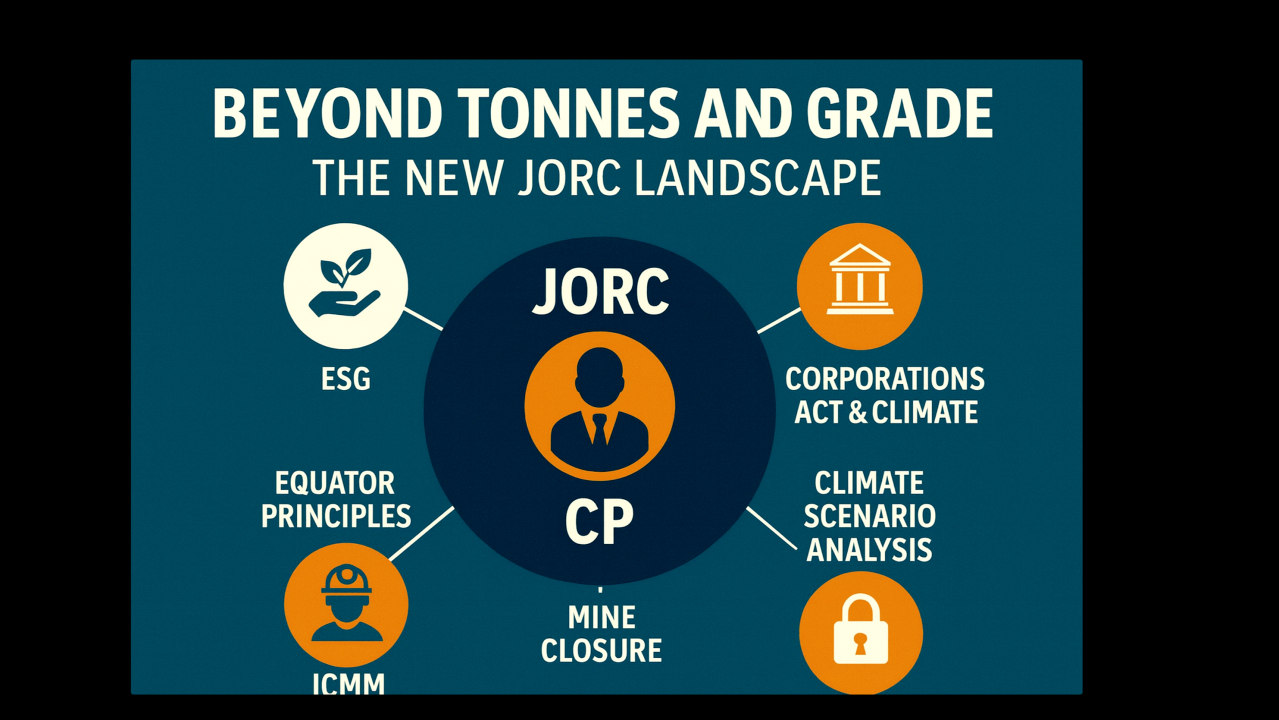
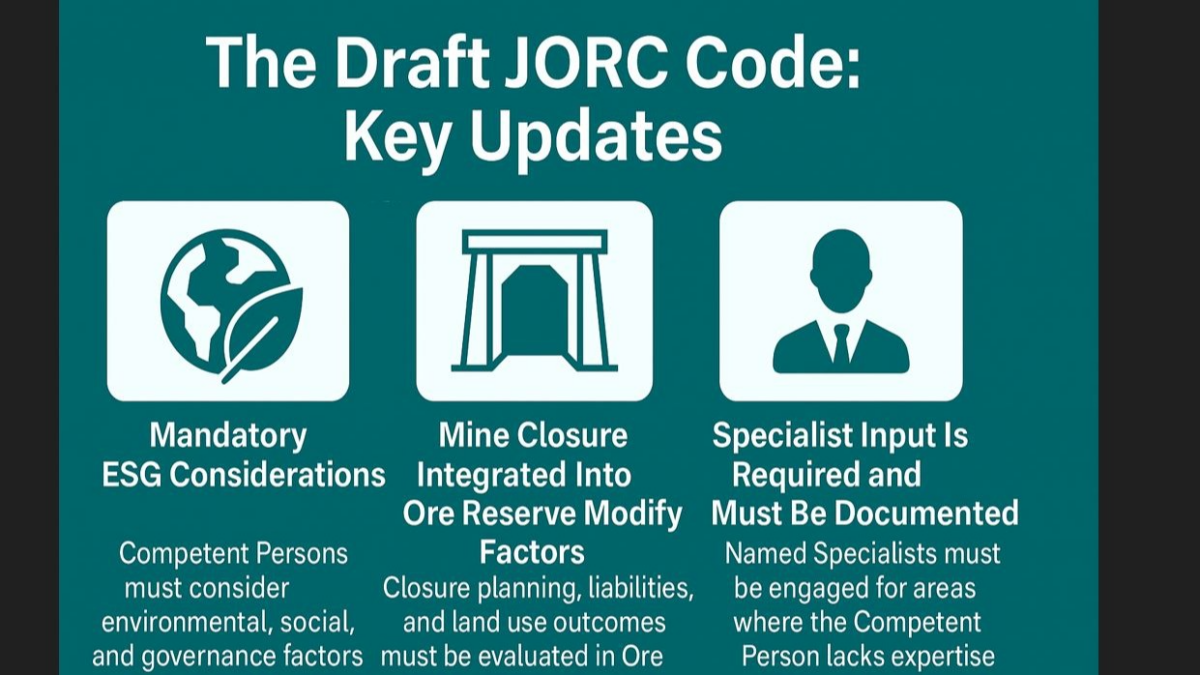
JORC is no longer only just about tonnes and grade.
By: Andrew Hutton, Managing Director, IEMA
For Australian mining companies, Competent Persons (CPs) are now operating at the junction of JORC, ESG, approvals, climate risk and mandatory reporting under the Corporations Act. That’s exactly where environmental and sustainability specialists – working in an aligned way with a deep understanding of the mining and resources sector – can de-risk disclosure and add real value.
What’s changing fast is not just the regulatory environment, but JORC itself. The 2012 JORC Code is under active review, with strong expectations that the next iteration will sharpen requirements around ESG, social licence and risk. When that lands, the demand for integrated technical–ESG capability around the CP will only increase.
This is how that landscape is shifting – and where practitioners like us IEMA – Integrating Sustainability, Business & Community can help CPs produce defensible, finance-ready Public Reports.
1. ESG moves into the Competent Person’s line of sight
The JORC Code (2012) is built on three principles – Transparency, Materiality and Competence – and requires Public Reports to include all information an investor would “reasonably expect” a CP to comment on. JORC Table 1 is clear: it is not a token appendix; it is a checklist of criteria that must be considered, with commentary provided on an “if not, why not” basis. [1]
For Ore Reserves, the Code goes further. Environmental, permitting, legal, social and mine closure issues are not “soft add-ons” – they sit explicitly within the “modifying factors”. If these factors can materially alter the economics, timing or viability of a project, they are squarely within the CP’s line of sight – even where detailed work is led by environmental, approvals or social specialists. [1]
Layered over the Code are powerful global frameworks:
- The Equator Principles (EP4) shape how project financiers assess environmental and social risk in mining and infrastructure projects. [2]
- The ICMM Mining Principles set expectations on climate change, water, biodiversity, social performance and mine closure for many of the world’s largest mining houses. [3]
In this world, a “purely technical” JORC report increasingly won’t pass muster – not with financiers, ESG-focused investors or regulators.
And with the JORC review widely expected to bring ESG and social licence issues further into the core of the Code, CPs will be under even more pressure to demonstrate that these modifying factors have been properly considered and explained by experts – not simply parked with “someone else in the team”.
2. The new regulatory overlay: Corporations Act, ASIC and climate risk
The risk for CPs and boards is no longer just reputational. The regulatory context around mining disclosure has tightened significantly.
- ASIC Info Sheet 214 on Mining and resources – Forward-looking statements sets expectations for production targets, financial forecasts and other forward-looking statements often built on JORC Resources and Reserves. [4]
- Kym Livesley’s paper Liability of Competent Person for JORC Reports is a blunt reminder: misleading or deceptive Public Reports can expose CPs to civil and criminal liability under the Corporations Act, as well as professional discipline. [5]
Climate has now been pulled into the same orbit:
- The Treasury Laws Amendment (Financial Market Infrastructure and Other Measures) Act 2024 (Cth) introduces mandatory climate-related financial disclosure for large businesses and financial institutions, phased in for financial years beginning 1 January 2025. [6]
- In-scope entities must lodge a Sustainability Report alongside their annual report, aligned with emerging Australian Sustainability Reporting Standards (ASRS), including climate scenario analysis, governance, strategy, risk management and metrics/targets (including emissions). [7]
- ASIC’s Regulatory Guide 280 – Sustainability reporting sets expectations for consistency and comparability in climate-related financial disclosures, and for clear linkages back to the OFR, prospectuses and other regulated documents. [8]
In practice, this means JORC numbers now feed directly into:
- life-of-mine production profiles used in climate scenario analysis;
- emissions baselines and growth trajectories;
- assumptions about closure obligations, rehabilitation liabilities and social transition.
If the JORC narrative is silent on key ESG risks or approval constraints – yet those same issues feature prominently in sustainability or climate disclosures – inconsistency and liability risk appear very quickly.
Add an updated JORC Code with clearer ESG expectations, and the standard for what is “reasonable” for a CP to consider is likely to rise again.
3. Where IEMA-style expertise fits around the CP
IEMA www.iema.com.au is now focused on competence in mine closure, environmental management, climate resilience and stakeholder engagement. That competency framework dovetails with the CP’s technical responsibilities.
Working alongside CPs, IEMA can:
- Translate complex approvals and ESG risks into clear, JORC-style “Materiality” terms.
- Structure impact and risk assessment so JORC Table 1, the Equator Principles and ICMM expectations speak the same language.
- Make sure the environmental and social assumptions used in climate scenario modelling under the Corporations Act are internally consistent with the resource/reserve story being told in the JORC report.
In short, IEMA expertise brings structure, depth and auditability to the non-technical aspects of the JORC narrative – precisely the areas now attracting regulator, investor and financier scrutiny, and the areas where a revised JORC Code is likely to sharpen expectations further.
4. Aligning JORC with Equator Principles and ICMM Mining Principles
Financiers applying the Equator Principles expect to see: [2]
- robust environmental and social impact assessments aligned with IFC Performance Standards;
- evidence that key impacts and mitigation measures have been identified, consulted on and built into project design;
- explicit consideration of climate risks and human rights.
ICMM member companies, meanwhile, commit to Mining Principles that require: [3][10]
- continual improvement in environmental performance, including climate and water;
- conservation of biodiversity and integrated land-use planning;
- strong community engagement, effective grievance mechanisms and responsible closure.
A CP working with IEMA can:
- Map JORC Table 1 commentary – especially for Ore Reserves – directly against Equator and ICMM requirements on community impacts, biodiversity, water, tailings, closure and human rights.
- Help articulate environmental and social modifying factors in language familiar to banks, export credit agencies and ESG investors.
- Flag gaps where additional baseline data, permitting commitments or community agreements are needed to support both Ore Reserve classification and financing due diligence.
The result: a project that is not only JORC-compliant, but also finance-ready – and better positioned for whatever a revised JORC Code demands on alignment with these global frameworks.
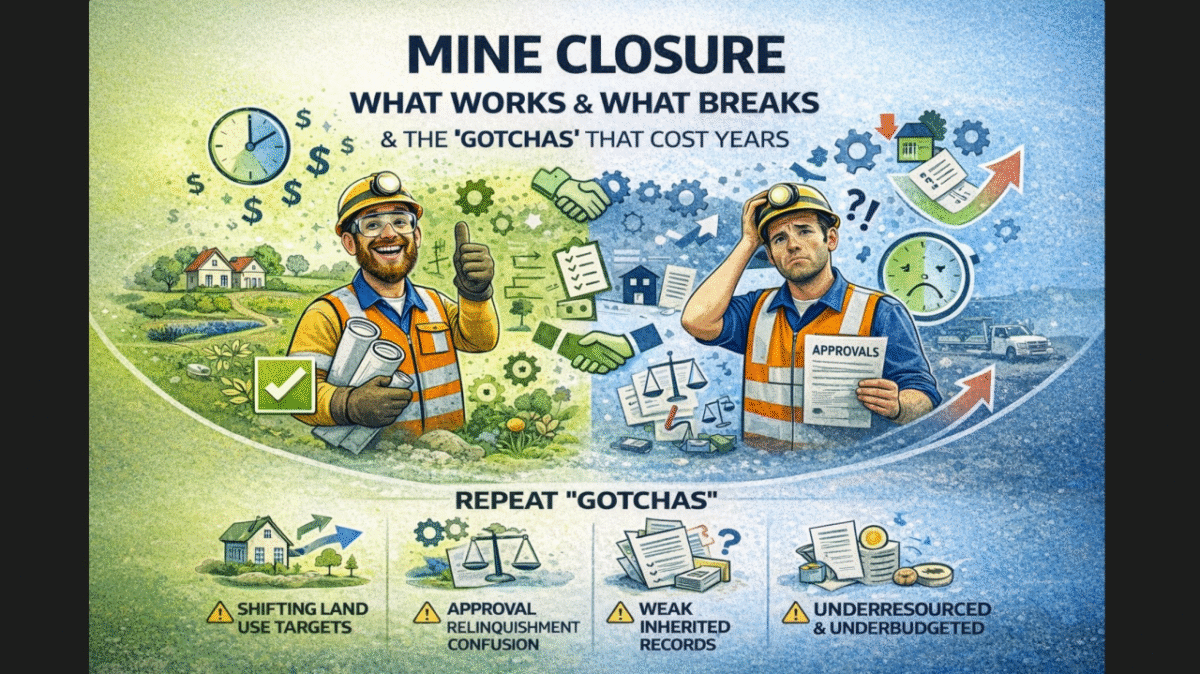
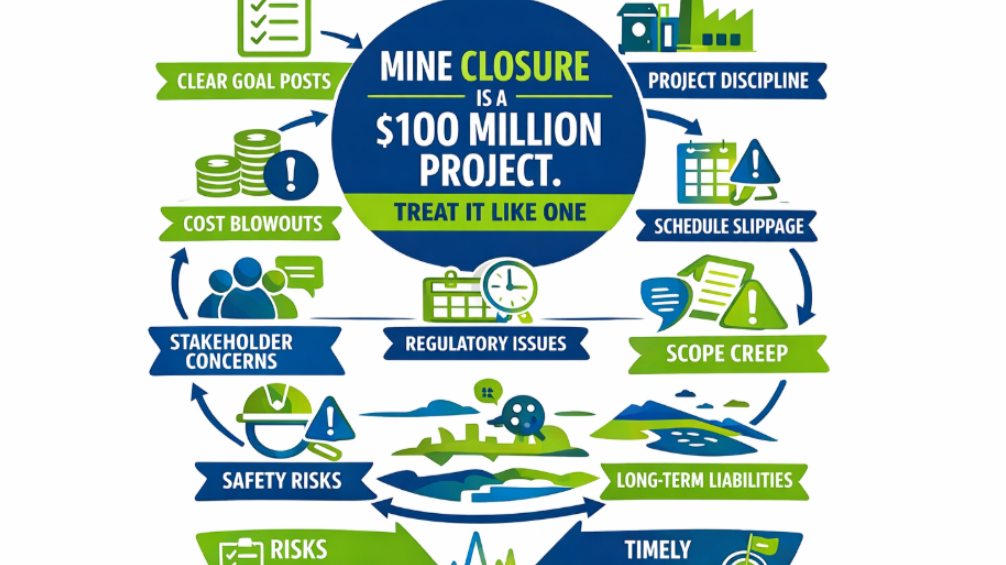
5. Mine closure: the discounted tail investors can no longer ignore
For decades, mine closure planning, outcomes and costs have sat at the far end of the cashflow model – deeply discounted in NPV terms and often treated as a problem for “later”. In practice, “later” is arriving much sooner.
Under JORC, closure is already a modifying factor. For Ore Reserves, CPs are expected to consider whether rehabilitation, closure obligations and post-mining land uses could materially affect the viability or timing of extraction. [1] That expectation is only likely to harden under a revised Code.
Several forces are pushing closure from the footnotes to centre stage:
- Accounting and sustainability reporting are bringing closure and rehabilitation provisions onto the balance sheet and into Sustainability Reports, where they can no longer be quietly absorbed in a distant terminal year. [7]
- ESG investors and lenders are scrutinising closure strategies as a litmus test of genuine responsibility – looking not just at cost estimates, but at final land use outcomes, long-term environmental risks and social transition for communities. [2][3][10]
- Regulators and communities are increasingly unwilling to accept vague end-of-life promises; they expect progressive rehabilitation, post-closure monitoring and credible funding arrangements to be locked in early.
For the CP, this means three things.
- Closure assumptions shape the resource and reserve envelope. Final land use scenarios, waste placement strategies, tailings designs and water management all feed back into pit limits, cut-off grades and mine life. If closure is tightened by new laws, standards or expectations, some material that looks economic in a spreadsheet may, in reality, have no “reasonable prospects for eventual economic extraction”. [1]
- Closure costs are increasingly material, even when discounted. In a classic NPV model, a big chunk of closure spend sits in distant years and is heavily discounted. But in the real world, closure obligations influence bonding requirements, corporate valuations, community trust and – under climate and sustainability reporting regimes – the story told to the market about long-term liabilities and risks. A CP who blindly accepts legacy closure assumptions without probing them risks signing off on an economic case built on outdated or incomplete liabilities.
- Closure outcomes are now part of the social licence test. ICMM principles and modern ESG expectations focus on responsible closure, post-mining land uses and community transition as core performance indicators, not afterthoughts. [3][10] Projects that cannot demonstrate credible closure outcomes may struggle to secure approvals, financing or community support – directly affecting the timing and classification of Ore Reserves.
This is a space where IEMA – Integrating Sustainability, Business & Community expertise is particularly valuable:
- developing realistic, scenario-tested closure pathways that reflect environmental, social and regulatory realities;
- checking that closure costs, timelines and outcomes used in the CP’s cashflows align with those disclosed in the company’s sustainability and climate reporting;
- ensuring that closure-related modifying factors are described clearly in JORC Public Reports, rather than buried in internal documents that investors never see.
In other words, closure is no longer just a distant clean-up bill; it is a present-day strategic and financial variable that warrants serious investigation and explicit treatment as a modifying factor.
6. Climate scenario analysis: joining the dots with JORC
Mandatory climate-related financial disclosure in Australia requires entities to undertake climate scenario analysis and to explain how climate risks affect strategy, resilience and financial performance. [9]
To do that credibly, companies need, for each scenario:
- realistic production profiles and mine lives grounded in JORC Resources/Reserves and mine planning;
- emissions trajectories (Scope 1, 2 and, where material, Scope 3);
- assumptions about physical climate risk (flooding, heat, water stress, fire) and how these influence operating costs, cut-off grades and closure timelines.
This is where structured environmental and climate expertise builds a bridge between the CP’s numbers and the board’s disclosures:
- Climate risk and scenario narratives can be framed so they are internally consistent with JORC assumptions (pit limits, strip ratios, processing routes, closure schedules and closure costs).
- Environmental approvals, water allocations, land access and community agreements can be stress-tested under different climate futures to see whether they threaten “reasonable prospects for eventual economic extraction” across parts of the Resource. [1]
- The Sustainability Report, Operating and Financial Review (OFR) and JORC Public Reports can be checked for alignment so they tell a joined-up story – one that meets ASIC and ASX expectations and avoids greenwashing risk.
Looking ahead, a refreshed JORC Code is unlikely to step back from these linkages; if anything, CPs may be expected to be clearer on how climate and nature risks intersect with their estimates and with long-term closure strategies.
7. Five practical ways we can support a Competent Person
In practice, collaboration between a CP and IEMA – Integrating Sustainability, Business & Community environmental/sustainability team tends to fall into five workstreams.
1. ESG materiality and stakeholder mapping for JORC Table 1
- Identify ESG issues that are material in JORC terms – approvals, water, biodiversity, Indigenous rights, local employment, closure, social transition.
- Distil this into focused Table 1 commentary and supporting documentation, avoiding vague or boilerplate text.
2. Approvals and permitting as a “modifying factor”
- Map the approvals pathway, key conditions, likely timeframes and dependencies for the project.
- Work with the CP to reflect this accurately in Ore Reserve classification, especially where approvals or land access materially constrain mine design or schedule.
3. Climate and nature risk integration
- Build a bridge between resource/reserve estimates and climate disclosures: production, emissions, nature impacts and physical risk exposure.
- Align assumptions with the new Corporations Act regime, ASIC RG 280 and emerging AASB sustainability standards, including scenario analysis requirements. [8]
4. Social performance and mine closure planning
- Use IEMA – Integrating Sustainability, Business & Community in stakeholder engagement and to support impact assessment methods to strengthen Social Impact Assessments, community agreements and progressive closure strategies.
- Ensure the JORC report clearly explains social and closure modifying factors in terms compatible with ICMM closure and social performance expectations. [10]
5. Governance, assurance and liability awareness
- Help CPs and boards understand how JORC Public Reports interact with forward-looking statements guidance (ASIC INFO 214) and climate disclosure liability settings. [4]
- Support stronger documentation, internal review and cross-checks so the CP can demonstrate they have taken “reasonable steps” – a key defence under both the JORC Code and the Corporations Act, as Livesley’s analysis underscores. [5]
Each of these workstreams becomes even more important as the revised JORC Code crystallises and expectations on cross-document consistency – especially around closure, climate and ESG – rise.
8. From “add-on” to strategic advantage
For many years, ESG, approvals, closure and climate reporting sat on the periphery of the CP’s world – something handled by the environmental team, the sustainability manager or the lawyer.
That era is over.
Today, JORC reports, Equator Principles due diligence, ICMM commitments, closure expectations and mandatory climate disclosures are tightly coupled. When they don’t line up, the CP, the board and the company all wear the risk.
As the next JORC Code comes into force – almost certainly with more explicit ESG, closure and risk language – that coupling will only get tighter. CPs who treat ESG and closure as optional extras will be exposed; those who build structured environmental and sustainability capability around their work will be better protected and better positioned.
Working with IEMA – Integrating Sustainability, Business & Community , a CP can:
- strengthen the credibility and defensibility of JORC sign-offs;
- improve alignment with financiers, ICMM members and ESG investors;
- and turn ESG and closure integration from a compliance headache into a strategic advantage.
If you’re a Competent Person, project director or board member grappling with these overlaps – particularly in lithium, critical minerals or other scrutiny-heavy commodities – the question is no longer if you should integrate ESG and closure into your JORC narrative, but how.
That’s the conversation we’re keen to have – and the space where we can help you build a reporting approach that is JORC-compliant, finance-ready and future-proofed against the next evolution of the Code.
References
- Australasian Code for Reporting of Exploration Results, Mineral Resources and Ore Reserves (JORC Code 2012), JORC https://www.jorc.org/docs/JORC_code_2012.pdf?utm_source=chatgpt.com
- The Equator Principles – About https://equator-principles.com/about-the-equator-principles/?utm_source=chatgpt.com
- ICMM – Our Mining Principles https://www.icmm.com/en-gb/our-principles?utm_source=chatgpt.com
- ASIC – Mining and resources: Forward-looking statements (INFO 214) https://asic.gov.au/regulatory-resources/takeovers/mining-and-resources-forward-looking-statements/?utm_source=chatgpt.com
- Kym Livesley – Liability of Competent Person for JORC Reports (AusIMM Bulletin) https://www.jorc.org/docs/liability_of_cp_for_JORC_reports-livesley.pdf?utm_source=chatgpt.com
- Treasury Laws Amendment (Financial Market Infrastructure and Other Measures) Act 2024 (Cth) – Bills Digest, Parliament of Australia https://www.aph.gov.au/Parliamentary_Business/Bills_Legislation/bd/bd2324a/24bd068?utm_source=chatgpt.com
- Australian Sustainability Reporting Legislation and Standards Guide – KPMG https://assets.kpmg.com/content/dam/kpmgsites/au/pdf/2024/australian-sustainability-reporting-legislation-standards-guide.pdf.coredownload.inline.pdf?utm_source=chatgpt.com
- Dentons – ASIC finalises its guidance RG 280 for climate-related financial disclosures https://www.dentons.com/en/insights/articles/2025/april/4/asic-finalises-its-guidance-rg-280-for-climate-related-financial-disclosures?utm_source=chatgpt.com
- Treasury – Climate-Related Financial Disclosure (Exposure Draft Explanatory Memorandum) https://treasury.gov.au/sites/default/files/2024-01/c2024-466491-exposure-draft-em.pdf?utm_source=chatgpt.com
- ICMM – Sustainable Development Framework: ICMM Principles (via Transparency Lab) https://www.transparencylab.org/Documentation/Industry-Related%20Actors/Industry%20Initiatives-%20Protocols-%20Standards/International%20Council%20on%20Mining%20and%20Metals_/ICMM%20Principles_2015.pdf?utm_source=chatgpt.com